
How Long Does It Take to Get Good at Festival Production?
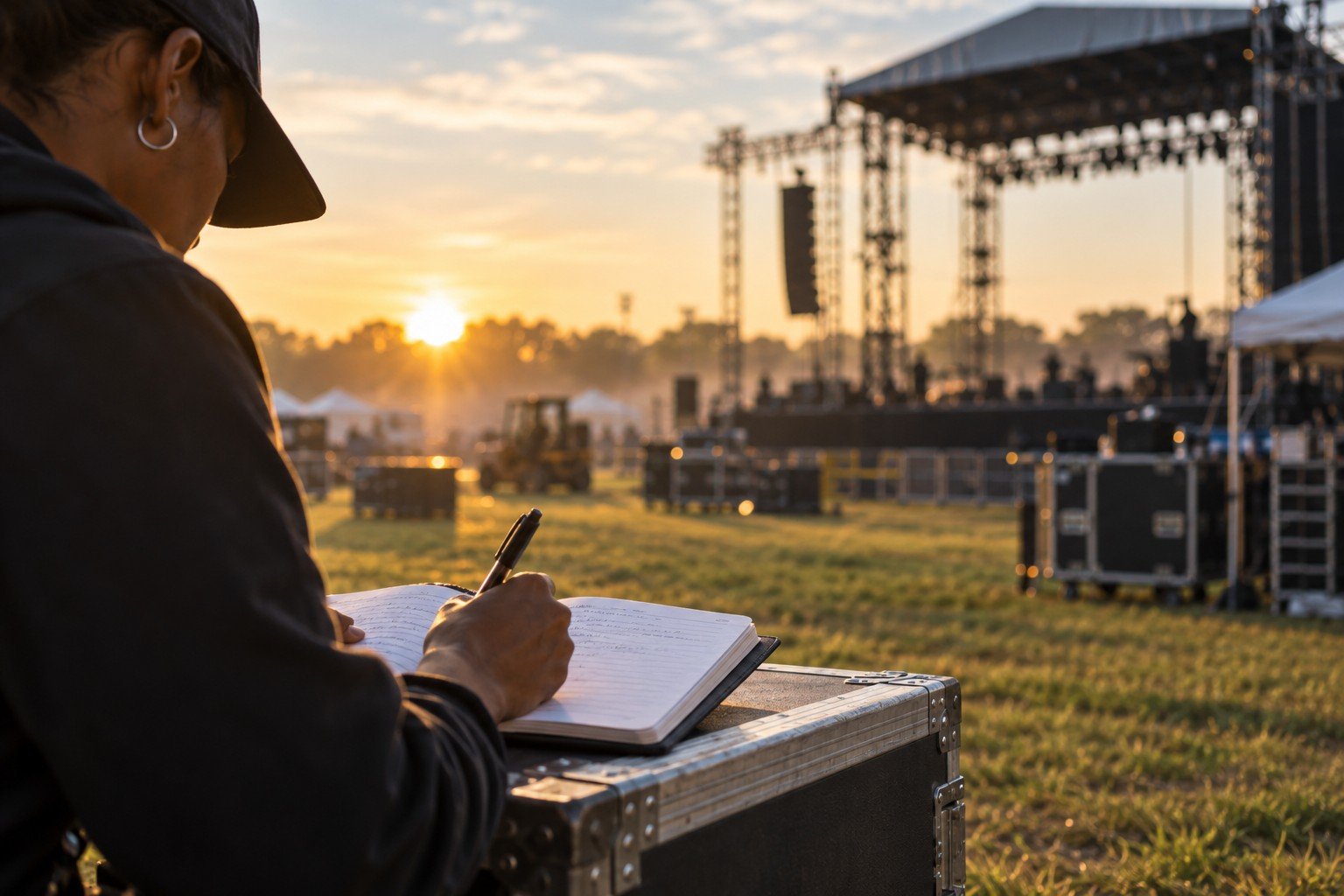
AI generated image
Emerging Leaders · Professional Development · Deep Identity
⏱ Reading time: 8 min.
A line cook in a busy restaurant runs something like three hundred services a year.
Three hundred times, the tickets come in, the pressure builds, something goes wrong, and they find out within minutes whether their fix worked. By the end of year one, they've had more reps than most festival producers get in a decade.
Because here's the thing nobody tells you when you start in this industry.
You get one festival a year. Maybe three, if you're lucky and you work more than one. One load-in. One gate opening. One weather call that you'll actually have to make with real consequences.
So when an emerging leader asks me how long it takes to get good at this, the honest answer isn't a number of years.
It's that the question is built on a broken idea about how people get good at anything.
The 10,000-hour idea doesn't hold up here
You've heard the rule. Put in ten thousand hours of focused practice and you'll become an expert at anything.
It's a comforting idea. It says the path is long but it's guaranteed. Just keep showing up.
The research is less comforting.
In 2014, a team of psychologists led by Brooke Macnamara pulled together every major study on deliberate practice they could find and asked a simple question: how much of the difference between good and great performers is actually explained by practice?
The answer depended entirely on the field.
In the Macnamara meta-analysis, deliberate practice explained 26% of performance differences in games, 21% in music, 18% in sports, 4% in education, and less than 1% in professions. Practice matters. It just matters far less in the kind of work most of us actually do.
Less than one percent. In professions.
That doesn't mean practice is useless. The researchers were careful to say it's important, just not as important as the popular story claims. And there's a real scholarly argument about how they defined practice in the first place.
But it tells you something anyone who's worked a festival already knows in their bones. Doing the thing over and over isn't enough on its own. There's something about this work that makes raw repetition a weak teacher.
Why festivals are a hard place to learn
The psychologist Robin Hogarth has a name for it. He divides the places we learn into two kinds.
Kind learning environments give you clear rules and fast, accurate feedback. Chess is the classic example. You make a move, you see the consequence, you adjust. The lesson arrives while you still remember what you did.
Wicked learning environments are the opposite. The feedback is missing, slow, distorted, or just wrong. You can do something badly and have it work out by luck. You can do something brilliantly and have it fail for reasons that had nothing to do with you.
Festival production is about as wicked as it gets.
Think about it. You make a staffing decision in February. You find out if it was right in May, if you find out at all. The weather either cooperates or it doesn't, and either way it masks whether your contingency plan was any good. A crowd moves smoothly and you'll never know if it was your layout or just a calm afternoon.
The Macnamara team found this too. In highly predictable activities, practice explained about 24% of performance. In the least predictable ones, it explained just 4%.
"You don't get good at festivals by doing more festivals. You get good by learning more from each one than anyone else in the room."
So how do you get more reps out of fewer seasons?
This is the part I wish someone had told me early.
I worked on a large-scale event that sucked continuously and didn't get audience traction.
We kept doing something based on a model that worked about a decade ago, and no one wanted to buck the leader. Quietly, everyone mumbled, grinned and bore it, and the event sank.
The audience had a destination on their calendar every year on the dates we chose, and everyone was too afraid to tell the leader they weren't coming to see us. And the event concept was fantastic.
I can never forget that experience. And now I'm not afraid, or should I say more courageous, to speak up. I've grown teams that have the same courage.
Yes, you have to honor the wisdom in the room. But if there's a glaring error in the creative decision and imagineering, you have to put on your big person undies and say it.
The worst that can happen is the event doesn't happen, and you save yourself from wiping egg off your face.
I've always been partial to eggs.
If you can't get more festivals, you have to get more out of each one. Here's what that actually looks like.
1. Write the debrief before the memory fades
A wicked environment gives you slow, blurry feedback. The fix is to make it sharper yourself.
Within a few weeks of load-out, write down what you decided, what you expected to happen, and what actually happened. Not a report for your boss. A record for you.
The gap between what you expected and what happened is where the learning lives. Most people never capture it, so by next season the lesson's gone and they make the same call again.
2. Separate the portable lesson from the local one
Some of what you learn only applies to your site, your crew, your weird loading dock. Some of it applies everywhere.
Learn to sort them. "Our east gate backs up at 2pm" is local. "Gates back up when the entry flow can't match the arrival curve" is portable, and it'll serve you at every event you ever work.
The people who get good fast are the ones who keep asking which kind of lesson they just learned.
3. Work more than one event
This one's simple, and it's the most direct way to get more reps. Volunteer on a second festival. Work a conference. Help a friend with a smaller event in the off-season.
Every extra event is another rep in a field that rations them. And a different event shows you which of your instincts are actually good and which only worked on your home turf.
4. Find someone who'll tell you the truth
In a wicked environment, you can't always trust your own read on how it went. You need someone who was there, who'll be straight with you, and who doesn't have a reason to protect your feelings.
That's rarer than it sounds. The people around you on a site usually report to you, or you report to them. Neither is set up for honest feedback.
Where your strengths come in
Here's where this gets personal, because the way you learn isn't generic. It runs through who you are.
One of my top strengths is Learner. I'm drawn to the process of getting better, sometimes more than to the result. That's a gift in this work. It's also a trap, because I can fall in love with learning and forget to write down the lesson.
Another is Strategic, which is the part of me that spots patterns across events. That's what makes the portable-versus-local sort feel natural to me. And Responsibility is what makes me actually sit down and do the debrief when I'd rather move on.
Your mix will be different. Maybe you're wired to learn through people rather than through reflection. Maybe your strength is in the doing, and the writing-it-down part is where you'll need a system.
The point isn't to learn the way I do. It's to know how you learn, so you can build your reps around it instead of fighting it.
Count Your Reps -- Check Yourself
- How many real events, with real consequences, did you work this past year? Count them honestly.
- Did you write down what you expected versus what happened, or are you relying on memory?
- Can you name one lesson from your last event that would apply at any festival, not just yours?
- Who in your working life will tell you the truth about how you did, without a reason to soften it?
- Do you know how your own strengths shape the way you learn?
A word to the ones just starting
If you're a student, or you're in your first few seasons, I want you to hear something clearly.
You're not behind because you've only worked a handful of events. Everyone in this industry is working with a rationed number of reps. The veterans just had more years to collect them.
What you can do, starting now, is learn more from each one than most people ever do. Debrief it. Sort the lessons. Find more events. Find someone honest.
Do that for five seasons and you'll have learned what takes some people fifteen.
I've watched it happen, over thirty-six seasons, in people who were far greener than they believed. It's not about how long you've been here. It's about how much you're paying attention.
The question was never really how long it takes to get good. It was always how deliberately you learn from the little time you get.
That's a skill. And like any skill, it can be built on purpose.
Festival Leadership Foundations
Learn More From Every Season You Get
A cohort-based program for festival and live events leaders, from first season to fortieth. Built around how you actually learn, with a room of people doing the same work alongside you.
See What's Inside →Sources. Macnamara, B. N., Hambrick, D. Z., & Oswald, F. L. (2014). Deliberate practice and performance in music, games, sports, education, and professions: A meta-analysis. Psychological Science, 25, 1608–1618. Hogarth, R. M., Lejarraga, T., & Soyer, E. (2015). The two settings of kind and wicked learning environments. Current Directions in Psychological Science. Hogarth, R. M. (2001). Educating Intuition. University of Chicago Press.