
The Months Nobody Sees
Festival Leadership · Production Culture · Deep Culture
⏱ Reading time: 6 min.
Signage and decor are a beast.
Ask anyone who's built a festival site. It's like getting ready for a great big house party. You want every flower in just the right place, even on the side table in the bedrooms nobody's supposed to wander into.
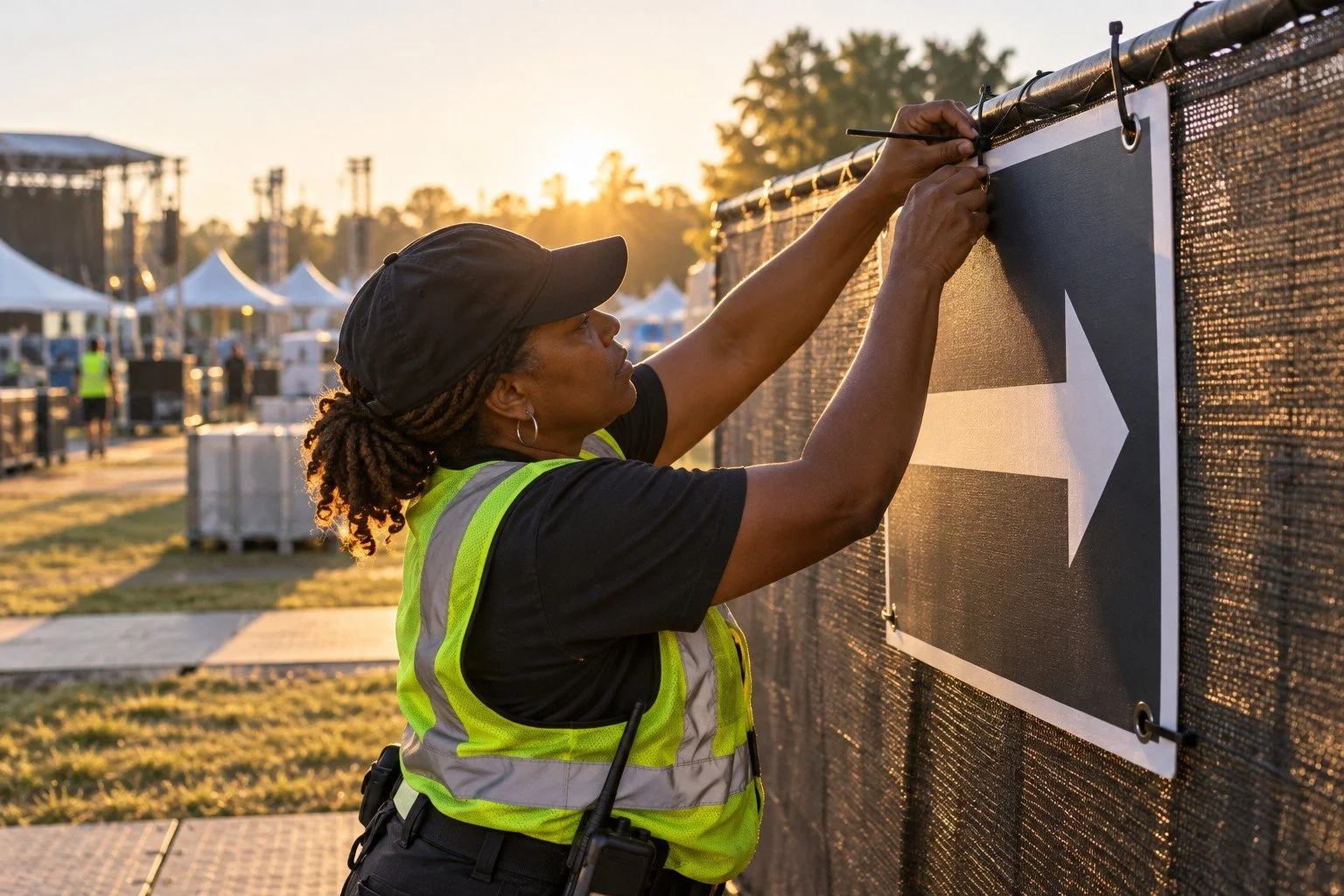
And no matter how many scheduling meetings we have, there's always a scramble at the end. Two hours before gates, somebody's still hanging the last fence scrim. Somebody's walking a dressing room sign back to the right trailer. Somebody's zip-tying a vendor sign that came off the truck in the wrong stack.
Hundreds of directional details. Each one telling a guest when to go left or right, without burying them in words.
Just the right balance.
When we get it right, nobody notices. Not one person walking through the gate thinks about the sign that sent them toward the food court instead of the wrong stage. They just get where they're going.
That's the festival. The part the crowd sees.
And it's not the hard part.
What's Really in Those Months
Festivals run a few days. The work behind them runs for months.
So let's name what's actually in those months.
The site map revisions. The vendor load-in windows. The credential lists. The radio channel assignments. The golf cart count. The weather calls. The ADA routes. The artist riders. The hospitality orders. The fence scrim. The dressing room signs. The production schedule that changes every time somebody says "quick question." I could go on and on.
Does that sound like your September? Because I'm telling you, it's mine every single year.
Maybe you run the whole site. Maybe you run one stage, one gate, one vendor village. Maybe you're a stage manager, a hospitality lead, a site coordinator, or a sponsor rep walking the activation one more time. And maybe you're producing your very first festival this season and wondering why nobody told you how much of this job is people.
This one's for all of you.
Because here's what I've learned. None of that list is the hard part either. Every item on it has a person behind it. A sign shop that needs the final file by Thursday. A runner who's been on the cart since 6am. A department head who found out about the change after everybody else did.
The work is the list.
The hard part is the people carrying it.
Good Signage Is a Leadership Skill
Think about what a good festival sign does.
It gives one direction. At the moment it's needed. In as few words as possible.
Too many words and people stop reading. Too few and they get lost. Put it in the wrong place and it might as well not exist.
Leading a crew through a build works the same way.
Your team doesn't need every update. They need the one that tells them where to go next. When a production meeting runs ninety minutes and everybody walks out with a different idea of what was decided, that's a signage problem. Too many words. No arrow.
When a department head hears about a schedule change from a vendor instead of from you, that's a signage problem too. The sign was in the wrong place.
The best leaders I've worked beside think about their people the way a great site designer thinks about a crowd. Where will they be standing when they need this? What's the fewest words that'll get them there?
According to the Event Industry Council, hourly event staff turn over at a rate of 63% a year. Every season, you're teaching a big share of your crew where left and right are all over again. The show depends on people who may not be back next year.
Where It Actually Gets Hard
In 36 seasons, I've watched the hard part show up in the same four places, over and over.
1. The Handoff
Between departments. Between shifts. Between the planning team and the build crew. Information leaves one person's head and doesn't fully land in the next. Nobody did anything wrong, and somehow the scrim still ends up on the wrong fence line.
2. The Scramble
The last 48 hours before gates. Everybody's tired. Everybody's sure they're right. This is when the way you talk to people gets remembered, long after the festival's over. One short answer at the wrong moment can undo a month of good work with someone.
3. The Conversation Nobody Starts
The vendor who keeps missing their window. The crew lead who's carrying too much and won't say so. Everybody can see it. Nobody brings it up, because there's a show to open.
4. The Morning After
Load-out ends. The site goes back to grass. And the real question gets answered without anybody asking it out loud.
Do they want to come back?
I haven't always gotten this right. There've been seasons where the event worked and the relationships didn't. But those seasons taught me the most, and they're why I build my teams differently now.
"The crowd sees the show. Your crew remembers how you led the months before it."
Before Your Next Build -- Check Yourself
- When you give your team a direction, can they repeat it back in one sentence?
- Do your department heads hear schedule changes from you first, or from someone else?
- In the last 48 hours before gates, do you know who on your team is running on empty?
- Is there a conversation you've been putting off until "after the show"?
- If you asked your crew today whether they'd come back next season, do you know what they'd say?
Culture Is the Signage You Leave Behind
Here's where this lands for me.
Culture works like signage. It tells your people which way to go when you're not standing there to point.
When it's right, nobody notices. The handoff just happens. The hard conversation gets started early. The runner on the cart at 6am knows exactly who to call, and isn't afraid to call them.
When it's wrong, everybody feels it. Even when the show goes off without a hitch.
That culture doesn't come from a policy or a slide in the pre-season meeting. It comes from who you are as a leader. How well you know your own strengths. Whether you can get still enough to think before you react. How you adjust when the plan breaks.
The inside work shows up on the outside. In your people.
The show is the part the crowd sees.
The people are the work. And the people are why it's worth doing.
That's the work at the center of Festival Leadership Foundations. Not more meetings. Not a thicker production book. The inside work that shapes the culture your crew walks into every season.
Festival Leadership Foundations
Lead the Months Nobody Sees
A leadership course for festival and live events professionals who want their crews to come back next season. Built on the Three Depths Framework™ and CliftonStrengths®.
Join the Waitlist →The waitlist hears first.