
When You Hit the Wall After the Season | Festival Leadership
Festival Leadership · Deep Stillness · Deep Identity
⏱ Reading time: 9 min.
At the end of June, I knew I needed to disappear.
Not forever. Just long enough to hear myself think again.
But I couldn't go yet. And if you produce anything for a living, you already know why.
Before the rest comes the closeout.
The debriefs. The departmental recaps. The one-on-ones that can't be rushed. The major meetings that only happen once the dust settles. The last decisions that were waiting on you and only you. The loose ends nobody else can tie, because they lived in your head all season.
I could go on and on. You know the list. You have your own version of it.
And I do mean you. Maybe you are a festival director. Maybe you run hotel and convention services, or venue operations, or catering and food service. Maybe you produce conferences and meetings, or run a cultural institution, or you just came off a tour. Maybe you are a coordinator holding far more than your title says you hold. And maybe, and I am thinking of you especially, you produced your very first event this year and nobody warned you about the part that comes after. Different rooms. Same closeout. Same wall.
This is a job that asks for your 6am and your 5pm in the same twenty-four hours. And that closeout stretch is its own kind of tired. It isn't the adrenaline of show days. It's the slow, heavy work of putting a season to bed. And it stands directly between you and the breath you are desperate to take.
So I did it. All of it. And then, finally, I stopped.
The Wall Has a Name
Here is what I didn't say out loud at the time.
I had hit a wall.
Not a breakdown. Not burnout the way we usually mean it, because I still had energy. I wasn't hopeless. I was just flat. Muddling through the days. Doing the things without the spark that usually carries me through them.
Adam Grant has a name for that place. He calls it languishing. The neglected middle child of mental health, the space between burnout and depression where you are not sick, but you are not thriving either. Not the valley. Not the peak. Just the fog in between.
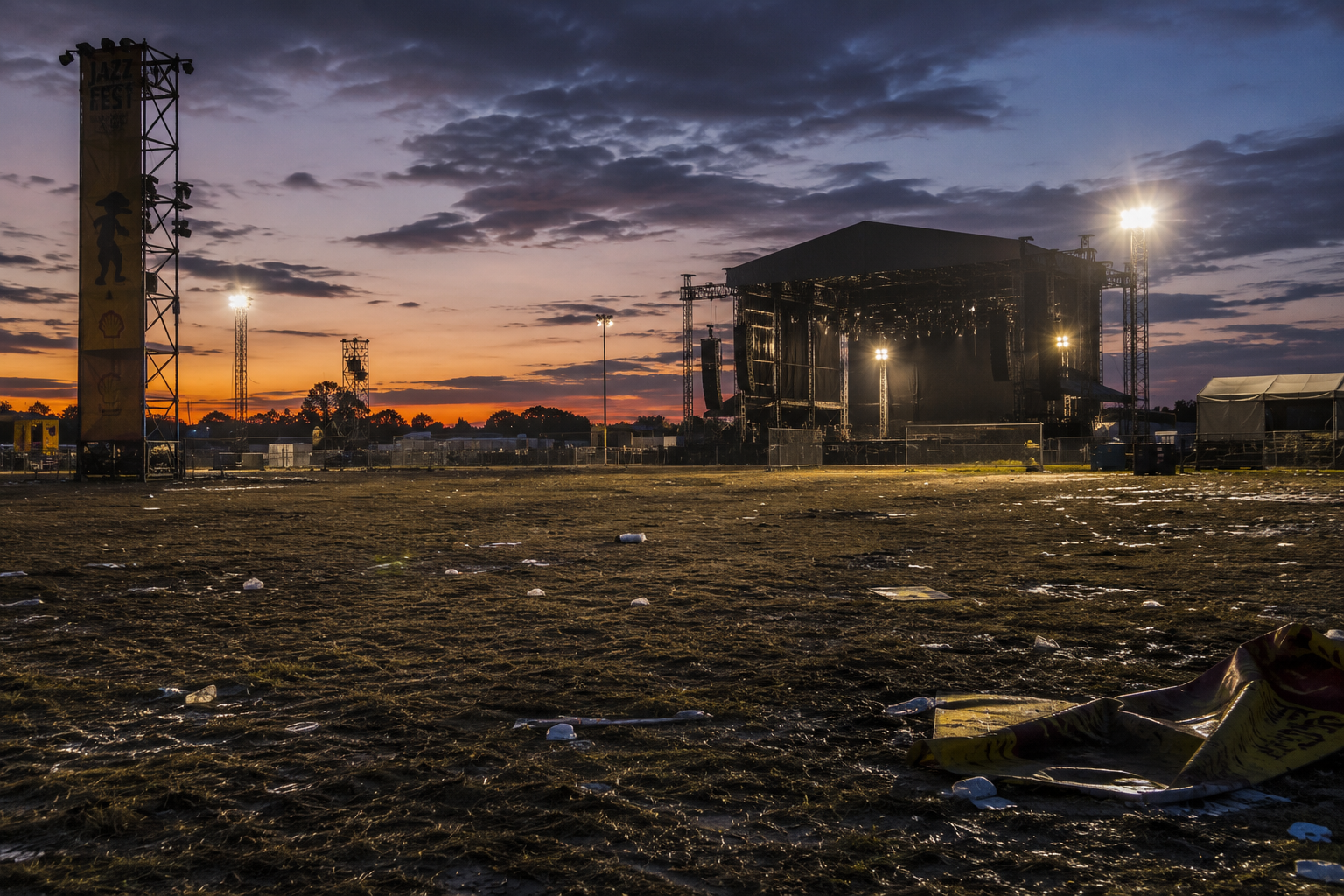
Grant calls it languishing. In festival world, I call it load-out syndrome. When the show lights go down, the work lights come up over an empty field, so the crew can strike in the dark and everybody gets home. The crowd's gone. The field's trampled quiet. But the light's still on. That was the season I was in. Still lit. Nothing running.
Does that sound familiar? Because in this industry, I'm telling you, it should.
A survey of nearly 1,500 independent music makers found that 73% had battled stress, anxiety, or depression tied to their work. Among the youngest artists, it climbed to 80%. These are the people we build stages for. And if the artists at the center of this industry are running on empty, the people producing around them, the directors and coordinators and crew, are not somehow exempt. We just hide it better.
Stopping Is Not the Opposite of Strength
Now, here is the move most of us make. We notice the wall, and we try to muscle through it. More coffee. One more push. We treat exhaustion like a character test.
I used to believe that too. I don't anymore.
There's a piece in Harvard Business Review I keep coming back to. Shawn Achor and Michelle Gielan, on resilience. Their argument lands hard: resilience is not about how long you can endure. It's about how well you recover. The lack of a recovery period is what actually holds your performance back, not the work itself. Stopping is not the opposite of strength. Stopping is where strength gets rebuilt.
Terence Mauri, who writes about leadership in fast-moving organizations, lands the same truth from another angle. Stop managing your time, he says, and start managing your energy. Time is finite, and that is a fight you will always lose. Energy you can rebuild. But only if you let yourself.
"Stopping is not the opposite of strength. Stopping is where strength gets rebuilt."
So I decided to stop on purpose. And I built the stop with structure, the same way I build anything I actually respect.
First came the step-down. A couple of weeks of lighter work over the back half of the season. Not zero. Lighter. Enough for my system to understand the season was really over.
And now comes the part I am writing my way into as I type this: a focused two to three weeks of real rest. It starts now.
And I have gotten specific about what rest is allowed to be. This part matters, so let me say it plainly.
I have been walking. Almost every day. Not for the step count. To get my rhythm back, and that healthy pep in my step that a hard season quietly takes from you.
When the New Orleans humidity turns that into a punishment instead of a practice, I move it indoors to the elliptical and keep going. And somewhere in there, the walking has started reviving parts of me that went soft sitting behind a computer all season. The body remembers what the calendar makes you forget.
The mind stays awake, but off the clock. Not grinding on problems. Just letting ideas move through without demanding I catch them and put them to work. In my ears: Daniel Coyle's Culture Code, Richard Rumelt's Good Strategy Bad Strategy, Charles Stone's Holy Noticing sandwiched in between. Considering. Not executing.
And underneath all of it, the music. Joao Gilberto. Dexter Gordon. Ella Fitzgerald. Ella Mai. Etienne Charles. Jimmy Smith. The sound of a life I actually like living, playing while I remember how to live it.
I am treating my health like it is the job. Because right now, it is.
That is not indulgence. That is maintenance on the most expensive piece of equipment your festival owns. You.
The Real Work Wasn't Rest. It Was a Reckoning.
But here is what the slowing down has already surfaced, before I even reach the deep end of this rest.
The quiet cleared just enough space for the real work to start. And the real work is not rest at all. It is a reckoning.
I have been living in deep identity mode. Cleaning house.
Eliminating mindsets I had outgrown but never retired. Facing habits that built up quietly across a hard season and started running the show. Breaking rote, looking hard at the places where "this is how we've always done it" had quietly stopped being wisdom and started being a cage.
Mauri names this better than I can. He talks about the courage to unlearn. Not just the curiosity to learn new things, but the harder discipline of retiring the always-done ways that quietly stopped serving you. And he draws a line I keep turning over: cultures of curiosity welcome the ideas that challenge how things get done. Cultures of conformity reject them. The same is true inside one leader. The mindset you refuse to question becomes the ceiling your whole team has to live under.
I have been the contingency queen my whole career. Always three moves ahead, always ready for what could go wrong. But you cannot contingency-plan your way out of a mindset that needs to be retired. That work only happens in the stillness.
And here is why this is not just personal. It's organizational.
The McKinsey Health Institute surveyed nearly 15,000 employees across 15 countries and found that one in four report burnout symptoms. But the finding that stopped me was this: the single biggest predictor of that burnout was not workload. It was toxic behavior in the workplace. The culture. The patterns. The things modeled from the top and absorbed by everyone below. Their conclusion was blunt. Stop treating the symptom. Fix the cause.
I read that and understood what my quiet was really for. When I clean house on my own mindsets and habits, I am not just recovering. I am working on the cause.
Here is what decades of building teams in this business have taught me. Culture is not the thing that happens to you while you are busy producing the show. It is the thing you are building whether you mean to or not.
Gustavo Razzetti, who has spent his career designing workplace cultures, says it cleanly. Culture is designed on purpose, not left to chance. And leaving it to chance does not mean you get no culture. It means you get one that forms around your worst habit instead of your best intention.
That is why the inner work is the real work. Daniel Coyle, whose Culture Code I had been walking with, found that the strongest cultures run on small, repeated signals of safety and belonging, and on leaders willing to show their limits first. You cannot build a culture of honesty for your team while you personally pretend you never hit a wall. They read what you model, not what you announce.
"Culture is the thing you are building whether you mean to or not."
So the mindset you retire, the habit you break, the conformity you refuse. That is not self-help. That is you clearing the ground your whole organization has to grow in.
This Isn't a Battle Scar. It's a Blueprint.
Let me get ahead of something, because I can already hear it.
Not long ago I watched someone push back on all of this. Impatient with leaders talking about being tired and stressed. Just do the work, they said. Stop showing your battle scars.
I understand the instinct. And I want to be clear about what this is, because it is not that.
I am not showing you a scar for sympathy. A scar held up for its own sake is just a complaint with better lighting. What I am handing you is the blueprint. The structure, the questions, the work, so the wall teaches you something instead of only taking something from you.
That is the whole difference. Vulnerability with no takeaway is a battle scar. Vulnerability that hands the next person a map is a foundation.
So let me connect this back to you, because it was never really about me.
The rest you keep postponing is not a reward you earn after the work. It is the work. It is where your judgment gets sharp again. It is where you finally see the pattern you were too deep in to name. It is where your culture, your relationships, your long-term strategy, and your own growth all get their next version.
The Off-Season Check -- Ask Yourself
- Did you take a real recovery window after your last season, or did you roll the closeout straight into the next build?
- Do you know the difference, for you, between rest that restores and rest that just distracts?
- What mindset or habit built up this season that is quietly running your decisions now?
- Where has "this is how we've always done it" stopped being wisdom in your organization?
- If your team is watching how you treat your own limits, what are they learning?
The Off-Season Is Where Your Next Season Is Built
I will be honest with you. I have not done this work perfectly. Across decades of this, I have powered through walls I should have honored, and paid for it later in ways that were harder to fix than a few weeks of rest ever would have been.
But I have learned to do it differently. And doing it differently is the whole game.
The off-season is not off. It is where the leader you will be next season actually gets built.
So here is my one ask. Before you start the next build, take the window. Even a short one. Then do the quiet work that nobody hands you a checklist for.
Your team is going to inherit whoever you become in that stillness.
Make it someone worth inheriting.
Festival Leadership Foundations
The Rest Is the Work. The Course Is Where You Build the System.
Cohort 2 enrolls Fall 2026 with locked-in waitlist rates for early registrants. Built for festival directors and live events professionals ready to lead from depth, not from urgency.
Join the Cohort 2 Waitlist →Locked-in waitlist rate ends when public enrollment opens.